Practical applications and technical challenges in the quantification of isoforms with Hoopbio solutions thanks to dPCR
Why is it important to detect BCR-ABL1 in leukemias?
The detection of the BCR-ABL1 fusion gene is one of the most significant milestones in the molecular diagnosis of leukemias. Its identification not only confirms the presence of certain hematological malignancies, but also allows for patient stratification, monitoring of disease progression, evaluation of response to treatment with tyrosine kinase inhibitors (TKIs), and diagnosis of potential relapse.
Clinical and molecular differences between BCR-ABL1 p210 and p190
The BCR-ABL1 fusion gene produces different isoforms depending on the breakpoint in the BCR gene:
- The p210 isoform (e13a2 or e14a2 transcripts) is primarily associated with CML and represents the standard molecular marker for this disease.
- The p190 isoform (e1a2 transcript) is common in Ph+ B ALL, associated with a more aggressive clinical course.
The differentiation between these isoforms has great clinical relevance, as it influences the prognosis, treatment design, and approach to molecular monitoring.
Technical difficulties in the detection and quantification of BCR-ABL1 isoforms 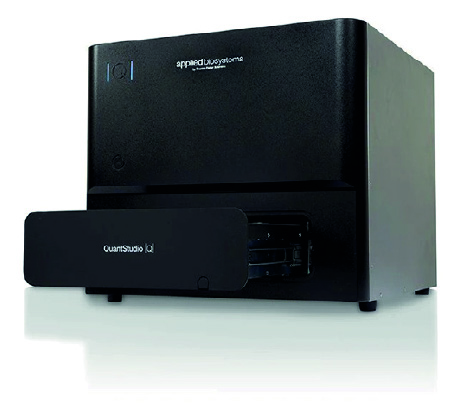
The accurate quantification of the p210 and p190 isoforms is mainly performed using RT-qPCR techniques; however, the use of this technique presents several challenges:
- A specific primer and probe design is required for each isoform.
- Sensitivity and reproducibility may vary depending on the protocol and quality controls used.
- There is a risk of cross-contamination or interference if rigorous protocols and internal quality controls are not in place.
- Longitudinal follow-up requires consistency between laboratories and comparable results on the international scale (IS).
All of this can be reduced by quantification by dPCR, which offers significant improvements in sensitivity, accuracy, and standardization.
HoopBio as a tool for the accurate analysis of BCR-ABL1
HoopBio is a platform designed to simplify workflow and maximize the benefits of dPCR in molecular diagnostics and cytogenetics laboratories. Regarding the detection of BCR-ABL1 p210/p190, it offers numerous practical advantages:
- Absolute quantification , very useful when there are few known objectives (<10).
- Elimination of the risk and/or concern of inhibition.
- Minimal Residual Disease (MRD): This test detects very small amounts of leukemia cells that persist after treatment, even though the disease is no longer detectable by conventional methods. This is very useful because it allows doctors to assess the effectiveness and response to a specific treatment, the risk of relapse, and to consider potential personalized treatments.
- Workflow automation : from data extraction to analysis, reducing technical variability.
- Real-time process monitoring , with alerts for critical deviations.
- Full traceability of samples and reagents , aligned with accreditation requirements.
- Clear visualization and data export , useful for both technicians and clinical hematologists.
Furthermore, its interface is designed to adapt to existing laboratory protocols, without requiring drastic changes to the daily routine.
The detection of BCR-ABL1 p210/p190 as a cornerstone in the monitoring of leukemias
Molecular diagnosis and continuous monitoring of the BCR-ABL1 p210 and p190 isoforms are essential for personalized medicine in the treatment of Ph+ leukemias.
Beyond the positive or negative result, it is the quality and traceability of the data that allows for informed and safe therapeutic decisions.
- Automate analysis: Facilitates the automatic interpretation of data generated by QuantStudio Absolute Q.
- User-friendly interface: Allows the user to configure, control and view results from an intuitive and centralized platform.
- Management and traceability: Integrates sample and results management, ensuring traceability and compliance with quality standards.
- Workflow optimization: Reduces the time from data loading to report generation, helping technicians and researchers work more efficiently.
- Quality control: Includes tools to monitor the quality of the runs and detect possible failures or inconsistencies.
The integration of intelligent tools like HoopBio, designed to work in synergy with advanced systems such as the QuantStudio™ Absolute Q™ Digital PCR System, optimizes this process, guaranteeing high-quality results that directly impact the prognosis and quality of life of patients.
If you'd like to learn more about BCR-ABL1 detection, or how HoopBio and the QuantStudio™ Absolute Q™ can help you in the lab, please don't hesitate to contact us . We're here to help!