A quartz torch that should last for months but degrades in a matter of days is not a manufacturing defect. It's devitrification : a well-known physicochemical process that occurs with matrices rich in alkali and alkaline earth metals, with high dissolved solids content, or with aggressive digestion. It's common in quality control of lithium-ion batteries, but by no means exclusive to that sector.
We review the mechanism, the matrices that accelerate it the most, and the ceramic tube alternative that Agilent has developed for the 5000 series detachable torches.
The mechanism of devitrification
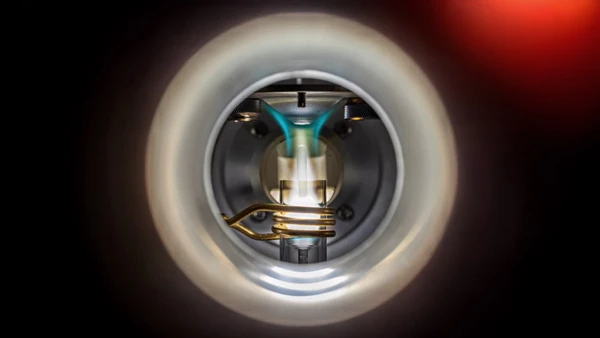
The torch is where the ICP-OES plasma is generated and sustained. It is made of quartz for its thermal resistance, but its structure—Si-O bonds—is vulnerable to penetration by certain ions when they ionize easily in the plasma.
Alkali and alkaline earth metals (Li, Na, K, Mg, Ca, Cs, Rb) are the main culprits: they penetrate the quartz lattice and break the Si-O bonds, replacing them. The result is a progressive loss of optical clarity and mechanical strength: the quartz becomes white or opaque, microcracks appear on the surface, and the material becomes brittle. The process is irreversible ; cleaning the torch may temporarily improve the appearance, but it does not stop the underlying degradation.
Matrices that accelerate devitrification
The phenomenon is not exclusive to a single type of sample. The conditions that most accelerate it include:
● Lithium-ion battery materials , with lithium concentrations that can reach 1% w/v in raw material or product quality control.
● High total dissolved solids (TDS) content , up to 35%, such as seawater or brines.
● Digestions with hydrofluoric acid (HF) , especially aggressive for quartz components.
● Geological melts with fluxes such as lithium metaborate or tetraborate, or sodium carbonate.
● Organic matrices (volatile and semi-volatile solvents), where deep UV radiation also causes additional solarization of the quartz.
In any of these scenarios, the lifespan of a quartz torch can be drastically reduced: in concentrated lithium arrays, from months to a period of days or, at most, a couple of weeks.
The alternative: ceramic outer tube
Agilent has developed a ceramic outer tube (silicon nitride, Si₃N₄) for the semi- and fully detachable torches of the 5800/5900 and 5100/5110 series ICP-OES instruments. The silicon nitride prevents alkali ions from penetrating the material, resulting in a lifespan up to 10 times longer than that of a conventional quartz tube in this type of array.
It is available both as a replacement tube (if you already have a detachable torch) and as a complete new torch already assembled with the ceramic tube, in DV (dual view) and RV (radial view) configurations. An important detail: the injector is not included and must be ordered separately; for the most resistant combination against aggressive matrices, it is recommended to pair it with an alumina injector (also ceramic), which is more durable against devitrification and solarization than a quartz one.
Outside of these main matrices, the ceramic tube also provides value in environmental applications (where cesium is often used as an ionization buffer) and in food applications, with samples high in salt or sugar.
What changes for your lab
✓ Up to 10 times longer lifespan compared to quartz tubes in demanding matrices.
✓ Fewer unplanned stops and fewer emergency replacements.
✓ Easy maintenance: the ceramic tube can be cleaned independently, even by burning off carbon residue in a muffle furnace at 550 °C.
✓ No method changes: it is a direct replacement for the quartz tube, no re-optimization is required.
✓ Full compatibility with semi and fully detachable torches of the 5000 series and with the entire range of quartz and alumina injectors.
Frequently Asked Questions
What is devitrification in an ICP-OES torch?
It is the degradation of quartz caused by the penetration of alkali ions (Li, Na, K, Cs, Rb) into its structure, which breaks the Si-O bonds. The quartz becomes white/opaque, loses strength, and eventually cracks. It is an irreversible process.
Why is lithium especially aggressive towards quartz?
Alkali metals such as lithium ionize very easily in plasma, and in concentrated matrices (such as those in the battery industry) they greatly accelerate devitrification, potentially degrading a quartz torch in a matter of days.
Does the ceramic tube directly replace the quartz tube?
Yes, it is a drop-in installation alternative for the semi and fully detachable torches of the 5800/5900 and 5100/5110 series, without the need to re-optimize the method.
Do I need to buy the injector separately? Yes, the injector is not included with the ceramic tube or torch and must be ordered separately. For aggressive matrices, an alumina injector is recommended, as it is more durable than a quartz injector.
Stop replacing torches every week
At Proquinorte, the official Agilent distributor in northern Spain, we help you assess whether the ceramic tube or the new detachable torch is right for your laboratory.
Proquinorte · near you / close to you · www.proquinorte.com