Oenology is, by definition, the science that studies the production and aging of wine. But if we scratch the surface, we discover that it is much more than that: it is a fascinating discipline where chemistry, biology, and history come together to rescue an age-old tradition from the clutches of chance .
Today on the Proquinorte blog , we delve into the secrets of oenology and how the laboratory managed to turn what was once considered an unpredictable miracle into one of the most fascinating precision industries in the world.
The day oenology became a science: The Pasteur effect
To understand the importance of modern oenology, one must travel back to France in 1863. Emperor Napoleon III had a serious economic problem: French wine, the pride of the nation, was mysteriously spoiling on ships before reaching its foreign buyers. In desperation, he commissioned an investigation by the chemist Louis Pasteur .
Pasteur locked himself in a cellar with his microscope and analyzed dozens of samples. His discovery laid the foundations of scientific oenology: wine was alive .
Until then, it was believed that the transformation of grape juice into alcohol was a simple, inert chemical reaction. Pasteur demonstrated that microscopic creatures (yeasts) were responsible for creating wine, while other, different bacteria were responsible for transforming it into vinegar if the environment was not properly controlled.
Curiosities of oenology: The hidden chemistry in your glass
Thanks to the development of oenology, we now know that a single bottle of wine is a complex universe composed of more than 1,000 different chemical substances . Through laboratory analysis, winemakers control variables that seem like science fiction:
- The pH shield: The pH of wine typically ranges between a tight 3.2 and 3.8. In winemaking, controlling this parameter is vital; a variation of tenths can mean the difference between a fresh, protected wine and an unstable environment where bacteria thrive.
- The sulfite dilemma ($SO₂): Although they're on everyone's lips these days, yeasts themselves produce them naturally during fermentation as a form of self-protection. Wine analysis measures free $SO₂$ with millimeter precision to protect the wine from oxygen without altering its organoleptic qualities.
- Polyphenols and the passage of time: They are responsible for the color and structure of red wines. By measuring them in the laboratory using spectrophotometry, oenology allows us to predict, immediately after fermentation, whether a wine is ready to age for years in barrels or whether it should be consumed young.
The modern laboratory: Guardian of wine's identity
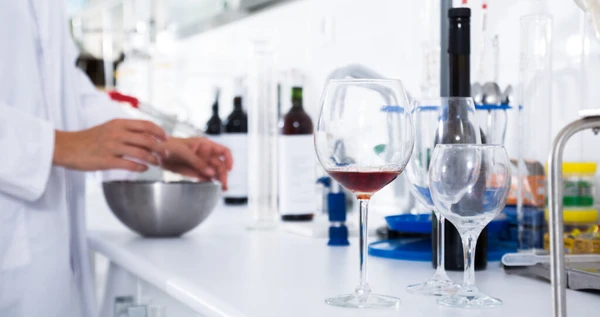
Modern winemaking does not aim to create artificial or identical wines. Quite the opposite. Analytical technology (such as automated enzyme analyzers or microbiological control systems) is used to give the winemaker "eyes" inside the tank.
Knowing exactly how much nitrogen the yeasts have to feed on, or watching out for stowaways like the wild yeast Brettanomyces (famous for ruining entire harvests with animal smells), is what allows the unique identity of each vineyard and each vintage to be protected.
At Proquinorte we are passionate about seeing how oenology puts science at the service of winemaking craftsmanship to ensure that every bottle approaches perfection.